Peter Cardinal's 1987 Marburg virus case
The Hot ZonePeter Cardinal’s 1987 Marburg virus case turned the death of a ten-year-old boy into a laboratory investigation and a renewed search for the virus’s hidden reservoir. After Cardinal died at Nairobi Hospital, Eugene Johnson received his blood serum and confirmed that it contained Marburg virus. The investigation traced Cardinal’s travels to Kitum Cave on Mount Elgon, a place also associated with Charles Monet, but did not determine how or where Cardinal contracted the infection.
The case and the search for an explanation
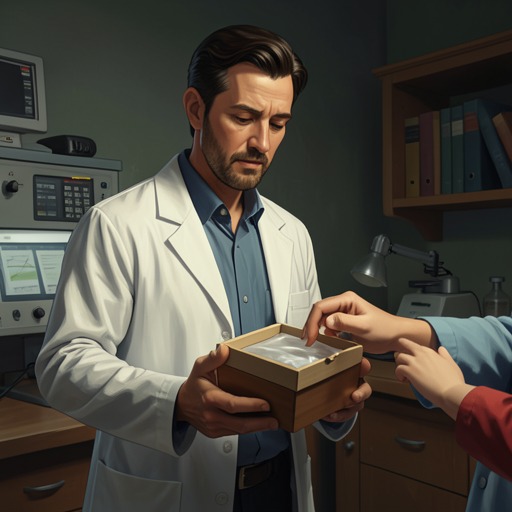
On September 2, 1987, Eugene Johnson waited outside the customs gates at Dulles International Airport for a passenger arriving from Kenya. The man handed him a taped cardboard box concealed in bath towels. It contained serum from Cardinal, who had died a day or so earlier at Nairobi Hospital. His illness had presented as an unidentified, severe infection of the kind that raised concern about a Level 4 virus. Johnson considered whether to destroy the sample without testing it, since most specimens sent to the Institute yielded no unusual agent. He decided instead to analyze it before the serum deteriorated.
Johnson opened the package in a Level 3 staging area and found a metal cylinder marked with a biohazard symbol. Inside were two small vials of golden serum. To work with their contents, he transferred the sample into a sealed Level 4 cabinet, where its rubber gloves allowed him to handle material without direct contact. The careful containment and the improvised, layered packaging made the sample’s journey part of the case: the serum had traveled from a fatal illness in Kenya to a laboratory in the United States, where its contents could be investigated under controlled conditions.
Cardinal’s family had come to Kenya through his parents’ work for a Danish relief organization. His parents lived in Kisumu, and his older sister attended a private school in Nairobi. Cardinal was a boarding-school student in Denmark; during his visit to Kenya, he and his sister spent much of their time together. The family traveled around the country, including a stay in Mombasa. When Cardinal became ill there, doctors initially diagnosed malaria. His mother doubted that explanation and pressed for him to be taken to Nairobi. The Flying Doctors air-ambulance service transported him, and he came under the care of David Silverstein at Nairobi Hospital.
Identification in the laboratory
Johnson inoculated living monkey cells with a small amount of Cardinal’s serum and watched for changes. The cells began to burst and die, evidence that an active agent was replicating in them. He then transferred fluid from the cultures into three rhesus monkeys. Two died; the third became critically ill but survived. A further test in guinea pigs also proved lethal, and the males developed markedly swollen, discolored testicles. Taken together, the results showed an agent that multiplied readily and caused severe disease in more than one species.
Johnson concluded that the agent was Marburg. Its ability to infect monkeys, humans, and guinea pigs informed the investigation’s central biological question: if it was so damaging in these species, might its natural host be another animal or insect that it did not kill? That remained a hypothesis, not an identification of the reservoir. The tests established the virus in Cardinal’s serum and demonstrated its effects in laboratory animals; they did not reveal the original source of his infection.
Mount Elgon and the shared cave
Once Marburg had been identified, Johnson sought a detailed account of Cardinal’s movements. He contacted Peter Tukei, a scientist at the Kenya Medical Research Institute, and asked him to locate and interview the family. Tukei later reported that Cardinal had visited Kitum Cave on Mount Elgon. That detail connected his case to Charles Monet’s: their paths had crossed at the cave, the one known place shared by the two cases. The overlap gave investigators a concrete location to examine, but the questions it raised—what the visitors touched or breathed, and what might live in the cave—remained unanswered.
The wider setting made the search more consequential without resolving it. Mount Elgon rises across the Kenya–Uganda border as an isolated, forested world above surrounding plains. Its slopes support villages and farms, while forest is cleared for firewood and grazing; elephants were also disappearing from the mountain. These conditions describe human activity and a changing habitat, not proof that any particular change caused Cardinal’s infection. The case likewise did not establish that the cave itself was the source. It supplied a shared lead in a landscape where the virus’s natural reservoir remained unknown.
Consequences and significance
The case converted a blood specimen into two kinds of evidence: a laboratory confirmation and a geographical clue. The experiments showed that Cardinal’s agent was a fast-replicating Marburg strain capable of killing macaques and guinea pigs as well as infecting human beings. The family history and travel investigation, meanwhile, placed Cardinal at Kitum Cave and brought his case into relation with Charles Monet’s. Neither line of inquiry closed the central gap between exposure and infection: the book does not establish precisely how Cardinal acquired Marburg or identify the reservoir in which the virus persisted.
That unresolved ending is essential to the event’s significance. Marburg had disappeared from view after earlier known cases, but Cardinal’s serum showed that the virus had not vanished. A child’s fatal illness renewed the search, while the matching cave location offered a way to frame it. The evidence narrowed the inquiry to a particular place and a set of biological possibilities, yet stopped short of a definitive origin story.